The European conference ‘Carbon Farming in the Mediterranean’ opens up new prospects for sustainable agriculture in the face of climate change
The Carbon Farming MED project brought together representatives from the European Commission, the Union for the Mediterranean, farmers and researchers from around ten countries in Barcelona to make progress towards a sustainable Mediterranean agricultural model and a carbon credit market.
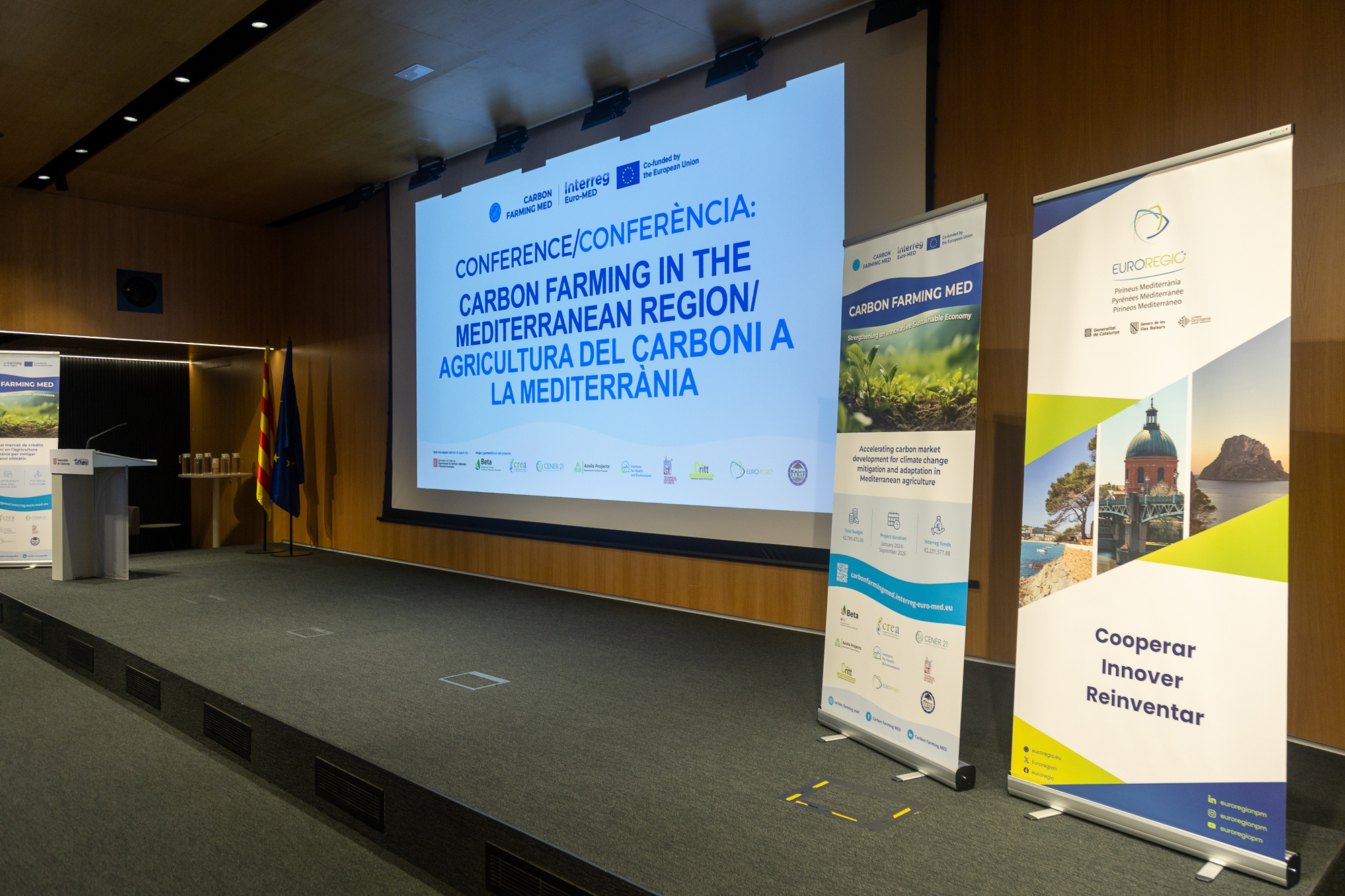
The conference “Carbon Farming in the Mediterranean” was held in Barcelona on 28 and 29 May 2026, with the aim of promoting a sustainable and resilient Mediterranean agricultural model capable of contributing to climate change mitigation. Organised by the Pyrenees-Mediterranean Euroregion and the Carbon Farming MED project consortium as part of the Interreg Euro-MED programme, with the support of the Government of the Generalitat of Catalonia (Department of Territory, Housing and Ecological Transition), the conference brought together high-level institutional and scientific speakers and representatives from the European Commission, the Union for the Mediterranean, several research institutions and the agricultural sector, to share their knowledge and advance common solutions.
The conference was opened by Sonsoles Letang, Director-General for Climate Change and Environmental Quality at the Government of Catalonia, alongside representatives from the Union for the Mediterranean — Dr Nisreen Tamimi, Deputy Secretary-General for Sustainable Development, and Joan Borrell, Deputy Secretary-General for Stability and Resilience — and by Guillaume Javourez, Project Manager at the Interreg Euro-MED Joint Secretariat.
The programme took place over two days. The first day, Thursday 28 May, was held at the Administrative District and was structured around four main thematic blocks, providing a comprehensive overview of carbon farming. The second day, Friday 29 May, consisted of a field visit to the Catalan pilot farm Verdcamp Fruits, located near Cambrils (Catalonia). This farm, which focuses primarily on horticultural and fruit production, is one of the pilot farms of the Carbon Farming MED project and implements pioneering regenerative farming techniques.
The first session of the conference was devoted to a review of the European regulatory framework and the specific challenges facing the Mediterranean region. Valeria Forlin, Deputy Head of Unit at the European Commission (DG Climate Action), presented the latest developments in the European regulation on carbon removals and carbon farming (CRCF), a key instrument for encouraging agricultural practices that capture CO₂ from the atmosphere. Alessandra Sensi, Head of the Environment and Green and Blue Economy Sector at the Union for the Mediterranean, then explored the specific challenges of carbon farming in the Mediterranean region, highlighting the area’s unique climatic and agricultural characteristics.
The second session was devoted to the presentation of the results of the Carbon Farming MED project by partners from the BETA Technology Centre, the Council for Agricultural Research and Economics (CREA, Italy) and the Centre for Energy, Environment and Resources (Bosnia and Herzegovina). In particular, a platform for calculating the carbon footprint of farms was presented. This tool, developed as part of the project, enables the quantification of carbon stored in soils as well as greenhouse gas emissions avoided. It provides farmers with the data needed to facilitate their participation in the carbon credit market. Agriculture can thus become both a genuine lever for climate change mitigation and a source of additional income for the sector.
The day continued with two panel discussions. The first gave the floor to farmers, with contributions from Eduard Muixach (Viticultors Muixach), Ricard Villanueva (Cooperativa Mas la Sala) and Boris Spassky (GreenPods, France), who shared the challenges and opportunities associated with implementing regenerative agriculture based on their practical experience. The second roundtable focused on financing the regenerative transition beyond carbon alone, with contributions from Valeria Forlin (DG CLIMA), Maria Cruz de Pablo Pecharromán (Triodos Bank) and Ralph K. Rosenbaum (IRTA).
The closing session was led by Luka Štrubelj, from the Legal Centre for the Protection of Human Rights and the Environment (PIC, Slovenia), who presented the Carbon Farming MED project’s policy recommendations for European and national legislators to facilitate the adoption of this agricultural model across the Mediterranean region.
Beyond the presentations, the conference provided a forum for debate and exchange, fostering the creation of synergies and new opportunities for collaboration between public authorities, scientific teams and professionals in the agricultural sector, thereby strengthening networking across the Euro-Mediterranean region.
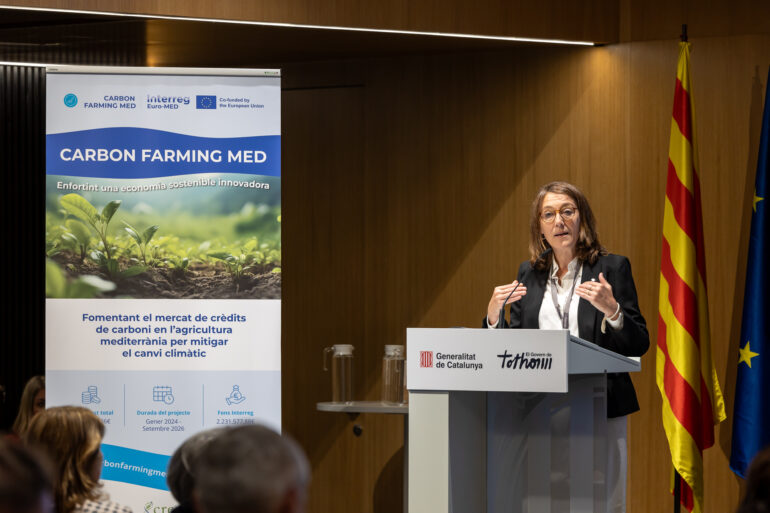
The Director-General for Climate Change and Environmental Quality at the Government of Catalonia, Sonsoles Letang
Press Release CAT | FR